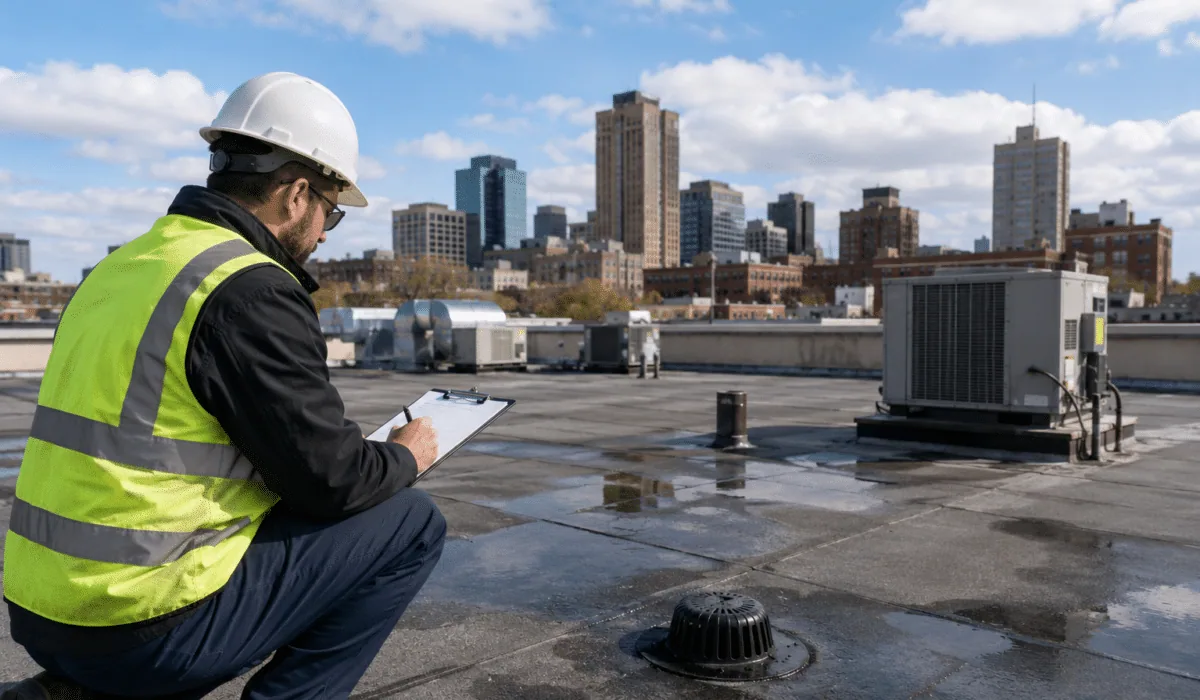
A split lap can feed water beneath the sheet before a ceiling gives any sign. In Ridgeway-Bulls Head, Stamford, CT, we follow the seam from the reported leak toward the curb, edge, and drain details that can carry water beyond the opening. Stamford's plan names Ridgeway-Bulls Head as a neighborhood within a mixed-use framework linking downtown and satellite centers. Commercial buildings in that setting need roof work sequenced with the activity below; we inspect the assembly, record the water path, and separate a contained defect from a wider system issue. A commercial roof inspection begins with the failure point and the detail that may be carrying water.
Leak route: follow the lap beyond the opening
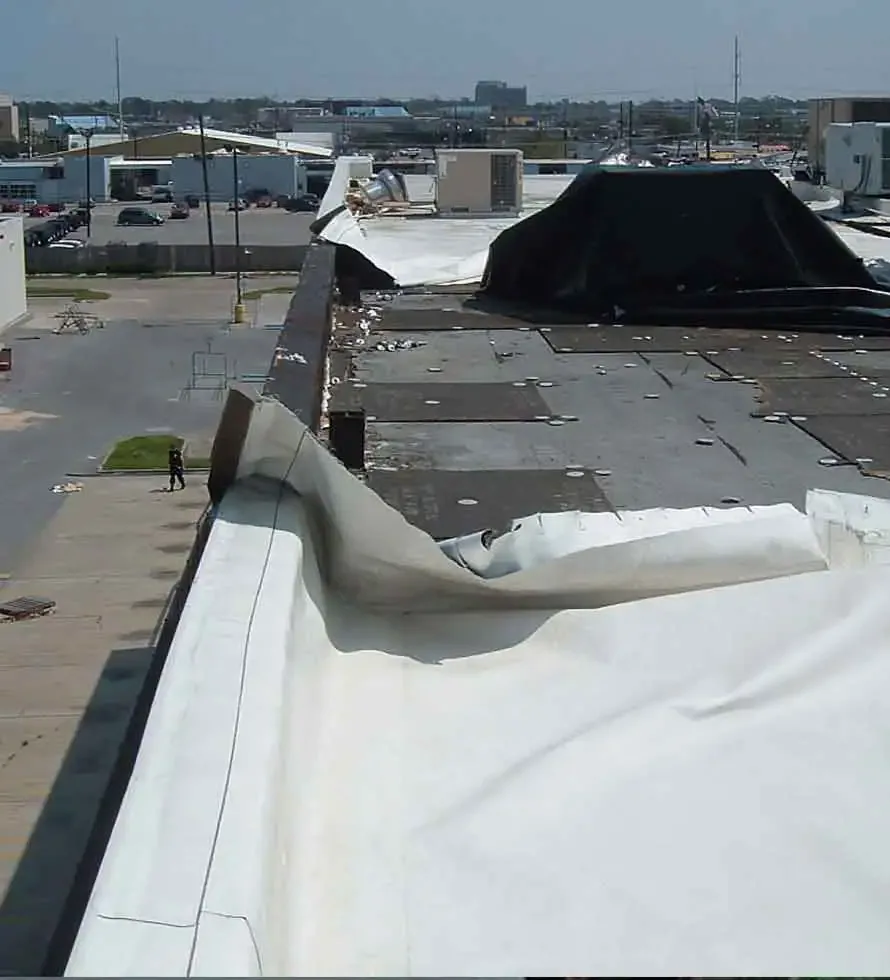
A stain can sit well away from the failed seam. Water may travel under a membrane, cross an insulation board joint, or collect beside a curb before it reaches the interior. We compare the leak location and timing with the roof slope, field seams, penetrations, and drainage. The walk looks for lifted laps, punctures, split flashing, displaced metal, and soft areas that may indicate wet insulation. Each observation is recorded separately from a suspected route so the written scope does not turn a possibility into a claim.
When a roof has more than one reported leak, we map each location before treating them as one problem. We identify whether the same seam or edge connects the reports and whether the substrate can be checked without a larger opening. Leak repair needs a boundary that reaches sound material and accounts for any wet layer below it.
Bulls Head framework: match work to the property
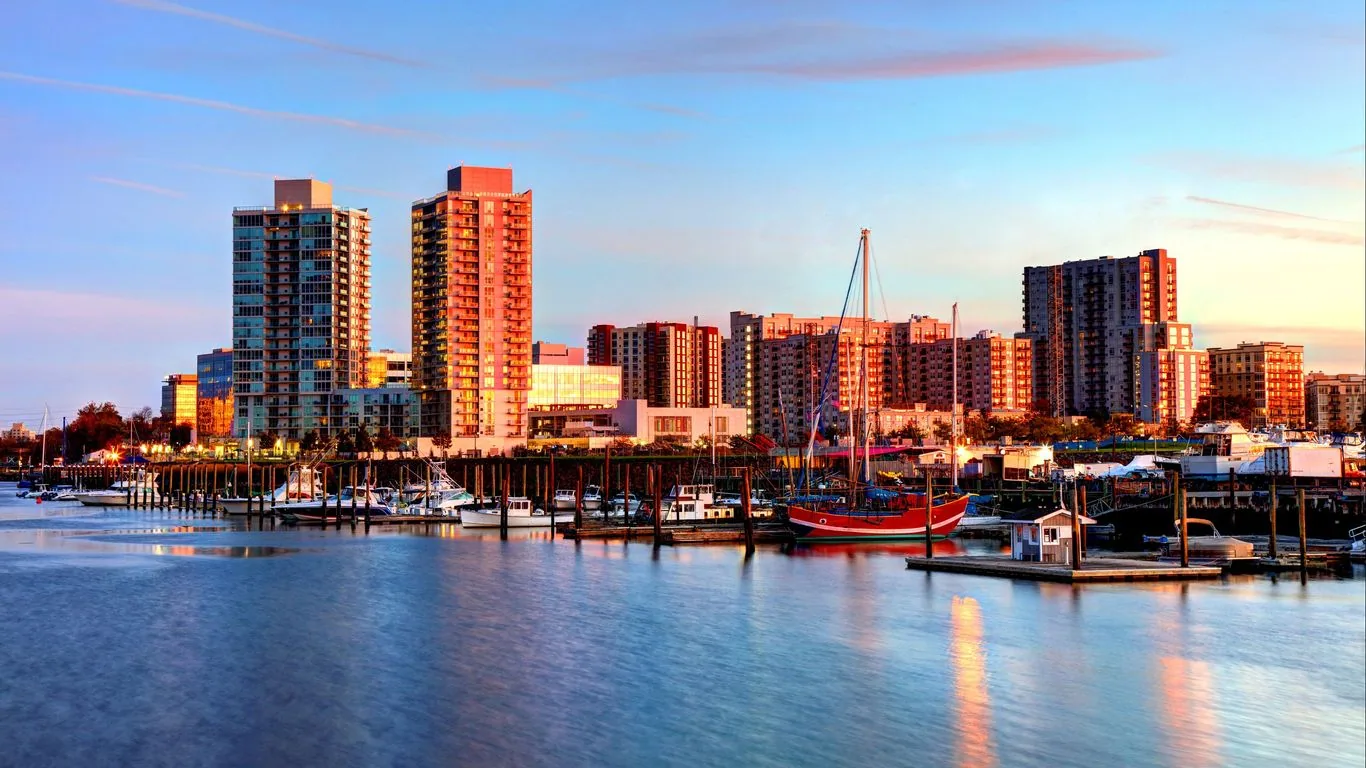
The city plan places Bulls Head within a mixed-use framework linking downtown and satellite centers. Its neighborhood-center policy pairs commercial nodes with nearby housing and public infrastructure. We confirm each property's occupancy and access route with its manager, then check the membrane, edge, curb, and drainage details that set the repair boundary.
Access arrangements can affect where tools are staged, which roof zones can be reached, and how a repair is sequenced around activity below. We record those limits with the condition notes rather than burying them in a general schedule. A roof near a public or shared route may need protection below and a clear material path. For a building in Waterside Stamford, we document its roof details, access limits, and repair boundary at that property. The inspection stays tied to the actual assembly and building access.
Parapet and curb: close each transition
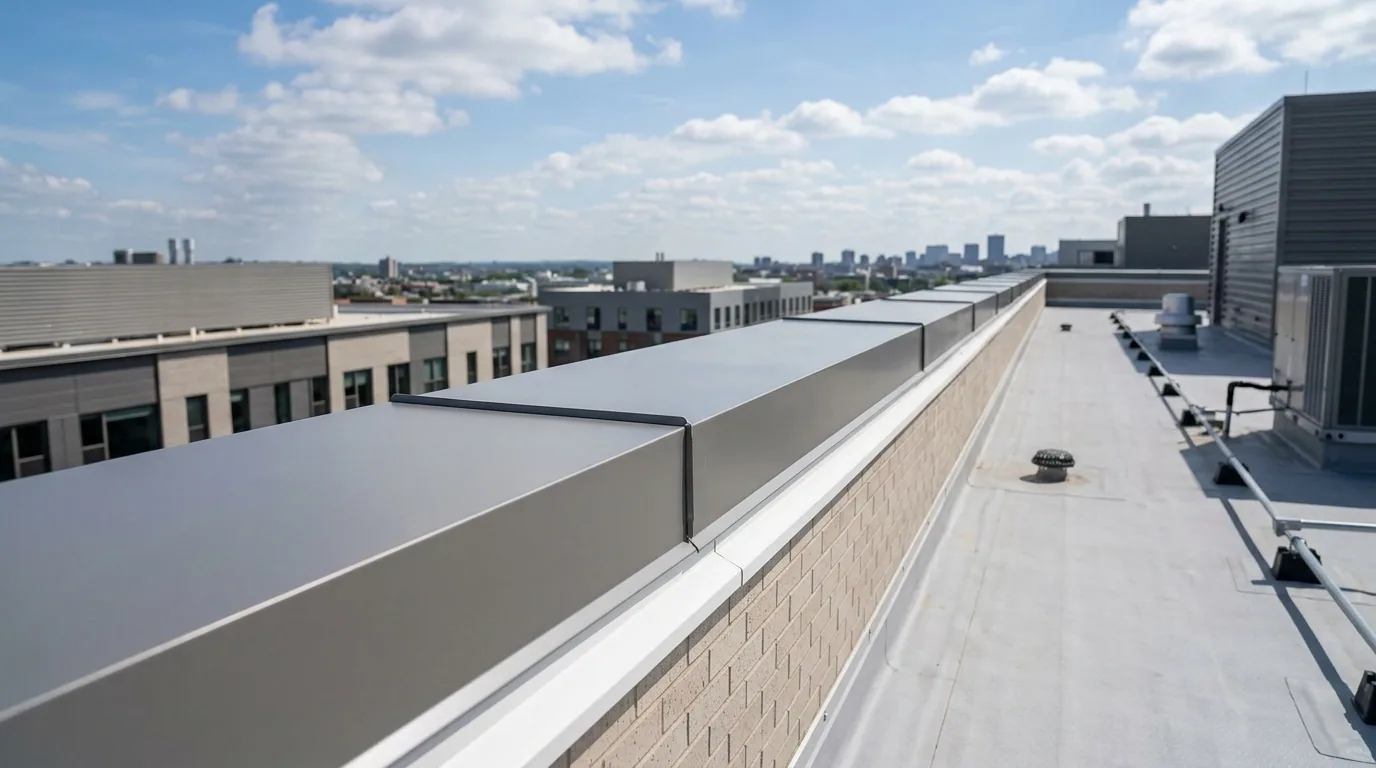
At a parapet, the membrane turn-up, termination bar, counterflashing, and coping all have to shed water as a connected detail. A loose metal splice or open corner can send runoff behind the wall. We inspect attachment, laps, sealant condition, and any separation between the roof sheet and metal. A visible gap may be local, but corrosion or movement along the edge can extend the repair. We identify how much material must be lifted to reach a stable surface before specifying the tie-in.
Curbs and equipment penetrations need the same careful boundary. We inspect curb corners, flashing height, nearby welds or adhered seams, and the service clearance needed by other trades. If equipment access can disturb the repair, the scope notes the work area and protection. Edge-metal and coping work should reconnect the perimeter without trapping moisture beneath a new layer. A curb repair may also require opening the field to determine whether wet insulation has traveled beyond the flange.
Drain bowl: check outlet and overflow conditions
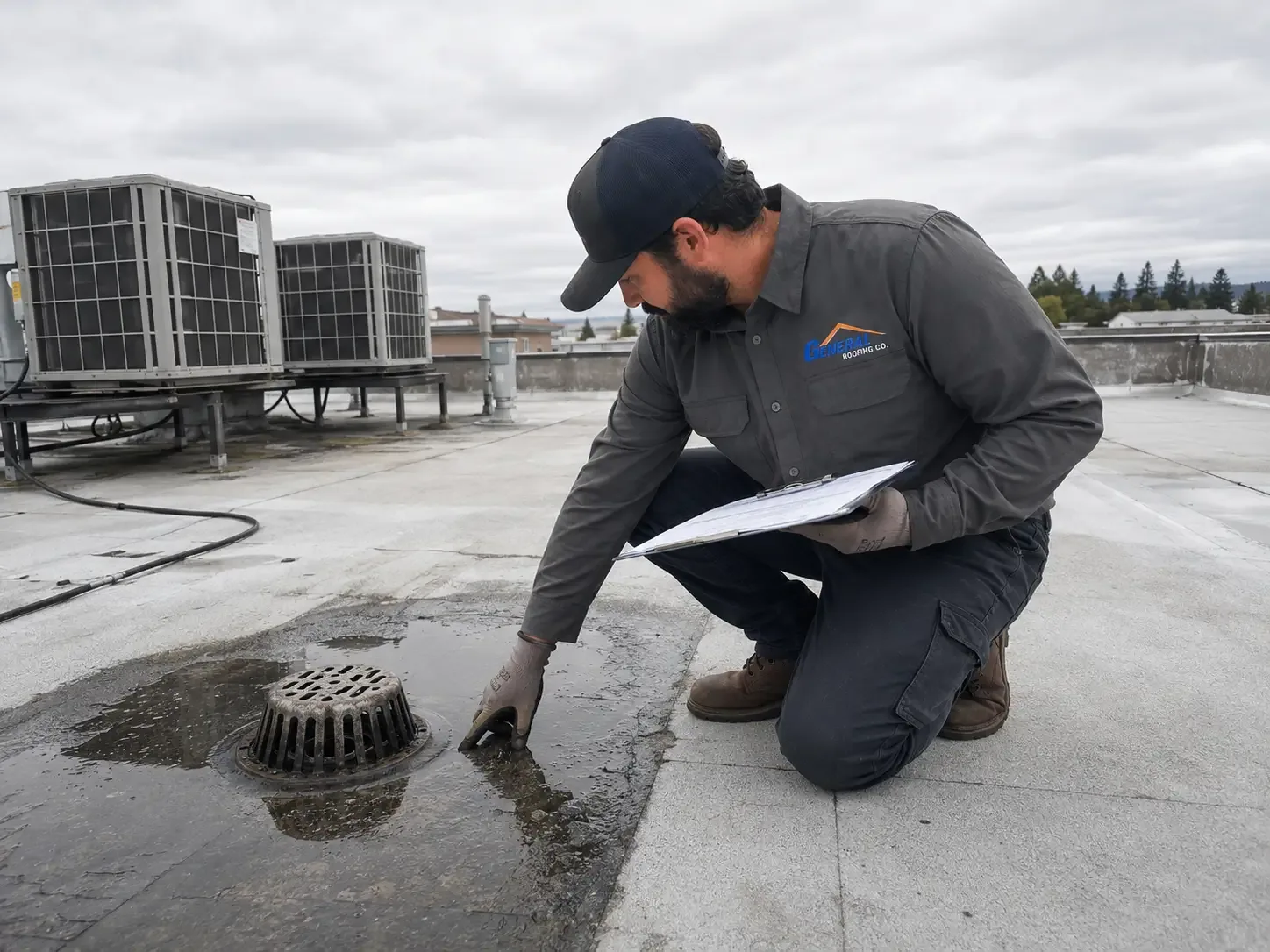
A drain that slows during rain can hold water against a seam or flashing transition. We inspect the strainer, bowl, clamping ring, membrane connection, and visible discharge route. Scuppers and overflow openings need clear paths and secure flashing. Cleaning can resolve debris, but it will not repair a loose flange, damaged membrane, or a low point caused by deck movement. We note whether water is present during the walk, where it remains, and whether the roof team has observed the same condition after different storms.
Drainage work often connects to nearby seams and penetrations. Water can pass beneath a sheet and appear at a curb that is not directly beside the outlet. Drain and scupper repair addresses both the opening and surrounding membrane. If the deck has moved or an insulation layer is wet, further access may be needed before the final boundary is known. The written scope should state that condition and any temporary dry-in needed while the assembly is open.
Stamford weather: inspect movement and water retention
Stamford's climate record includes recurring winter snowfall and subfreezing overnight temperatures. We look closely at outlets, laps, and terminations where water can linger and pass through freezing and thawing. That does not determine a roof's load capacity; the building's design and current condition govern that question. We record a blocked drain, separated seam, or visible movement and identify whether a separate structural review is needed. The repair scope remains tied to observed roof conditions.
Summer daily highs in Stamford's NOAA normals reach the low-to-mid 80s Fahrenheit, with cooling-degree demand. Heat can increase movement at metal returns and exposed membrane transitions, while equipment penetrations create more places for flashing to separate. We inspect those details rather than treating temperature as proof of failure. Membrane repairs require system-compatible preparation, and the material found on the roof controls the method.
Repair boundary: leave sound material in place
At a Ridgeway-Bulls Head roof, the first decision is whether the opening stops at one lap or continues into the field. We check adjacent sheet, attachment at the seam, and the material exposed at the cut before setting a repair size. A stable surrounding surface can accept a new tie-in. If moisture has moved past the initial opening, the boundary follows the affected insulation, and the exposed edge stays protected until the added work is agreed.
Several separated failures can change the recommendation. Repeated leaks, broad wet insulation, or loose attachment may call for maintenance, coating evaluation, recover, or replacement rather than another patch. Preventive roof maintenance can address developing wear when the assembly is still serviceable. A condition report preserves defects and repair limits for budgeting. The larger-system option should be based on the remaining membrane, deck, drainage, and use of the building.
Cost and timing: state what changes the work
Price depends on roof system, the size of the repair, number of connected details, removal, wet insulation, equipment access, and protection required inside. A curb repair may involve both flashing and field membrane. A drain opening may need a broader cut to reach dry substrate. Testing and temporary close-in can also add steps. We identify the base scope and the conditions that could change it so the property manager can see what is included.
Timing follows weather, safe access, substrate dryness, and material preparation. New membrane cannot bond properly to wet or contaminated surfaces. For a larger repair, dry-in and final installation may need separate visits to protect the interior between steps. For a roof in North Stamford, record its repair boundary, photos, and remaining maintenance items against that property.
Commercial Roofing Questions
Does the mixed-use plan tell you what roof types Bulls Head properties have?
No. It describes a land-use framework, not individual roof construction. We inspect the assembly, membrane, deck where visible, and connected details before choosing the repair method.
Why might a leak show up away from the failed seam?
Water can move under roofing or through insulation before reaching the ceiling. We compare reported locations with seams, curbs, edges, and drains to find where the path begins.
Can a drain repair stay limited to the bowl?
It can when the flange, membrane connection, and surrounding substrate remain sound. A loose edge, wet insulation, or low deck can widen the repair area.
Which concealed roof conditions can change a ridgeway-bulls head repair quantity?
Wet insulation, deteriorated deck, loose attachment, or a longer-than-visible membrane split can add work. The scope identifies those conditions and how they will be handled.